







Tag Archives: childhood obesity

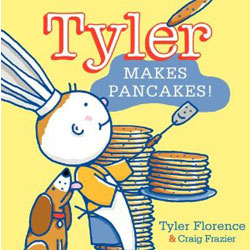
‘Tyler Makes Pancakes’ Aims to Get Kids Eating Healthy Through Food Awareness

In an era of obesity in our country, the message of healthy eating and knowing where our food comes from has become more important than ever; especially when it comes to our kids.

And in this great time of need for awareness, powerful movements like Michelle Obama’s Let’s Move and Jamie Oliver’s Food Revolution have sprung up to get our nation thinking more consciously about our health.

The latest of those movements? Tyler Florence’s new children’s book ‘Tyler Makes Pancakes,” which teaches kids about the importance of eating healthy through the story of a little boy named Tyler and his curious dog, Tofu.

Throughout the book, the likable pair go on fictional adventures to discover where food comes from and how to cook with it. One such adventure takes them to a local farm where Tyler learns that eggs come from chickens. Small lessons such as this can teach young children a surprising amount about the importance of eating whole foods. (more…)

Disney to Ban Capri Sun, Lunchables, and Other Unhealthy Advertisers

The Walt Disney Company made an announcement today concerning the type of advertising they will allow on their kid-friendly web sites, radio and television stations. The move by Disney is designed to curb childhood obesity and requires advertisers to meet a strict set of nutritional rules. These standards will also be enforced on the Saturday morning cartoons that are run on stations owned by Disney, like ABC.

Disney’s decision will obviously result in some lost advertising revenue, but the company believes that the end outcome is more important. Due to current contracts that are in place, these changes will not take place until 2026. At that time the new standards will apply to programming targeted at children 12 and younger.

Some of the products that will be excluded under the new restrictions include Capri Sun drinks, Kraft Lunchables, candy, sugared cereal and fast food. Disney isn’t just enforcing higher nutrition standards, they are also changing the food served in their parks. They plan to reduce the sodium on all of the children’s meals served at their theme parks by 25 percent. (more…)

Chef Jamie Oliver Puts Children’s Health Before Food

Jamie Olivermay not be a fitness guru, but he has revolutionized the food and health industry. Born May 27, 1975 in Clavering, Essex, England, Jamie had a normal childhood until the age of 8 when he started working at his parents’ pub The Cricketers in Calvering. He would help around the kitchen and run errands for his parents. Jamie was around the kitchen so much that he found a passion for food. He completed training at Westminster Catering College at 16 years old and then France was calling Jaime’s name. He spent some time there working for a variety of restaurants. Upon his return to London he worked at Neal Street and then at the infamous River Cafe for three-and-a-half years with Rose Gray and Ruth Rogers. This is where his passion for Italian food was ignited.

His formal career started in 1997 after being featured in a documentary about the River Cafe. Jamie was offered his own show; thus The Naked Chef was born. Jamie kept himself busy with his projects, but gave back to the community. In 2001, he opened “Jamie’s Kitchen,” a training restaurant for English citizens who weren’t in school or employed. His open heart and love for cooking benefited people in need. The next project to catch Jamie’s attention was the poor state of school lunches in United Kingdom schools. In 2004, Jamie launched a national campaign called “Feed Me Better,” then went into schools and educated kids on the importance of eating healthy. “Feed Me Better” shed light on the obesity problem eradicating the UK. (more…)

5 Companies Fighting the Childhood Obesity Epidemic

With one in six children in the U.S. now considered obese, our nation has a big problem on its hands. But thankfully, some innovative companies are developing fun and healthy ways to help kids battle the bulge. 

The first idea is from brothers Ernest Ebio and David Catanghal who love doing Crossfit workouts and wanted their kids to be able to join in the fun. So they created a company called WOD (workout of the day) Toys, which sells kid-sized barbells, medicine balls and kettle bells for instants and toddlers.

The toys are safe for little ones to slug around as they weigh between one half to four pounds each, and are made with kid-friendly materials such as plastic, polyester and leather.

Since its inception, the company has seen near instant success and is already doing $10,000 in monthly sales. “Kids love to mimic their parents,” Ebio told CNN in a recent interview. “My daughter can be with us [now] and have fun with these toys while mommy and daddy work out. As she grows up, we hope she associates exercising with something fun and positive and develops a love for fitness.”

(more…)

One American’s Journey Through A Korean Diet

“Sometimes love and appreciation for a different cultural food comes immediately. In Korea, the diet was a love I had to take a lot of chances on. It had to woo me, and I allowed it. Over time it has become a culinary experience that I will always cherish.”

These are the words of blogger, photographer and world traveler Andrew Phelps, who’s most recent resume addition includes English teacher in Korea.

During his more than two-year stint overseas, Phelps said one of the things that intrigued him most about Korea was the food. Born and raised on an American diet, the blogger says he was thrown into culture shock from the change in food the moment he and his wife arrived in South Korea.

“…Before I left U.S. soil to teach in the far east, I just assumed that all Asian food was similar to Panda Express. I couldn’t have been more wrong,” he said. “Korean food is incredibly unique to the Asian continent.” (more…)

Eli Manning Partners with BOKS to Get Kids Healthy and Fit

Winning a national championship is not the only thing Eli Manning can put on his resume. The Superbowl-winning quarterback is also an ambassador for Building Our Kids’ Success (BOKS) – an organization that works with schools to get children moving more throughout the day for both physical and mental health.

The fact that today’s generation of youth has more interest in electronic devices than playing sports or running around outside is just one of the numerous factors contributing to childhood obesity. Poor diet and a lack of exercise are two more. Currently, 9 million children over the age of six are considered obese. And comparatively speaking, obesity in America has taken a turn for the as obesity rates have more than tripled in recent years.

Growing up, children cherish memories of recess and gym class in elementary school. Recess is that critical break that children need to get away from classroom studies and relish in the benefits of fresh air and physical activity. While national guidelines recommend 60 minutes of physical activity a day, schools have started to limit recess time and physical education classes in order to achieve more time in the classroom. (more…)

Type 2 Diabetes on the Rise in Youth, Epidemic Declared

For years, health experts have predicted that Type 2 diabetes would become a severe problem among today’s youth as obesity rates continue to rise. Unfortunately, those predictions are coming true. For the first time ever experts have conclusive evidence that Type 2 diabetes among youth has reached epidemic-status, and only seems to be worsening.

Researchers analyzed data from a study of more than 3,800 youth ages 12 to 19 who participated in a federal survey. According to the report published in the journal Pediatrics, researchers found that the number of teens with diabetes or ‘pre-diabetes’ (individuals showing early signs of diabetes), rose from 9 percent in 1999 to 23 percent in 2026.

Previously, health experts and physicians rarely saw diabetes in kids. But it’s becoming more and more common as more children in our country are being diagnosed as overweight or obese. This news is especially alarming as diabetes is also known to cause such related issues as blindness, nerve damage, heart attack and stroke. (more…)

How 12-Year-Old Marshall Reid Inspired His Family To Get Healthy

They say it takes a village to raise a child, but sometimes, it takes a child to inspire a village.

Such was the case with Marshall Reid, a 12 year old from Sanford, North Carolina, on a mission not just to change his own health, but the health of his family and millions of other Americans who struggle with their weight as well.

Marshall’s weight loss journey began after a school bully pointed out his biggest insecurity. “One of my classmates actually told me you don’t look very good. You’re fat,” he said. Already feeling self conscious about his weight, Marshall then happened to watch the documentary ‘Super Size Me’ and decided that wasn’t the lifestyle he wanted.

So he told his mom, Alexandra, that he wanted to get healthy – that he was done with eating unhealthy foods. And he proposed the family eat the opposite of the way they’d been eating – primarily fast food and take out – for the next 30 days to see if they could stick to it. She said hearing the news felt like somebody threw a brick at her chest.

(more…)

California Teens are Eating Less at School, a New Study Reports

Is it possible that the West-coast population is eating less than us East-coasters and Midwesterners? According to a new study, that may be the case; especially when it comes to California teens.

The new study published in the Archives of Pediatric and Adolescent Medicine found that California teens are eating less at school. And although the margin may be small – about 158 calories – nutrition experts say this could make a big difference in the long run, especially since they also seem to be eating less added sugar and fat than students from others states.

The 14 other states included in the study reportedly have less strict nutrition standards, which may potentially be the reason their students are consuming more calories during the school day. But what isn’t clear is why California students also seem to be eating fewer calories at night when they arrive home from school.

Authors of the study say California’s nutrition laws are what’s likely contributing to the surprising results, since the state limits the amount of unhealthy snack foods and sodas schools can sell to students – including the content of vending machines. (more…)

Why Schools are Banning Bake Sales and Birthday Cakes

Bake sales used to be the highlight of any school function, with mountains of cupcakes and muffins, and bundt cakes galore, tempting the taste buds of kindergartners and teachers alike. But that may be changing soon, as schools are beginning to make bake sale restrictions in light of America’s ever-expanding waistline.

The public school system in Maryland’s Montgomery County, for instance, is no longer allowing its districts to hold bake sales, even if the fundraisers are for a good cause. This is because selling sweets has been outlawed during the school day, and the new ban is taken rather seriously, according to Marla Caplon of Montgomery County’s food and nutrition services, who says officials ‘make the rounds’ daily to ensure no one’s breaking the rules.

“If a bake sale is going on, it’s reported to administration and it’s taken care of,” she says. “You can’t sell Girl Scout cookies, candy, cakes, any of that stuff.” (more…)

Study Shows Mothers Struggle to Identify a Healthy Weight For Kids

The words obese and toddler should never even be in the same sentence, but in today’s society, that seems to be becoming the trend.

With more than 12.5 million children and adolescents in the U.S. deemed as obese, it’s becoming more and more of a problem. And the issue seems to no longer lie just in the age of those children  – which keeps getting younger – but also in the parents’ ability to assess their child’s individual health.

New studies are showing that it’s difficult for parents to know what a healthy weight is for their toddler-aged children. After all, baby fat is cute, right? Well maybe, but depending on how much of it there is.

A group of researchers in the Baltimore, Maryland, area gathered a group of 281 mothers from local clinics that served primarily low-income families. Seventy-one percent of the participants were African-American mothers. Researchers chose primarily low-income families because that demographic has a higher risk of becoming overweight or obese.

In the study, participants were shown a collection of toddler silhouettes in a range of sizes and weight, and were asked to pick which one best matched their own child. They were also asked which silhouette they most desired their child to resemble. Both mothers and children were also measured for weight and height. (more…)